Bible Verse and This Evil Will Rise Again Just Before Jesus Returns.
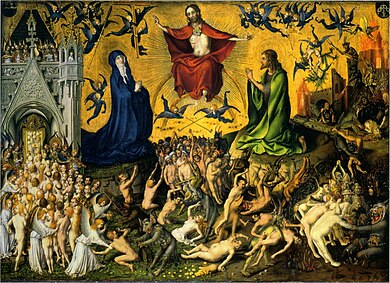
The Terminal Judgment, Final Judgment, Day of Reckoning, Solar day of Judgment, Judgment Mean solar day, Doomsday or The Twenty-four hours of the Lord (Hebrew: יום הדין, romanized: Yom ha-din , Arabic: یوم القيامة, romanized: Yawm al-qiyāmah , lit.'Solar day of Resurrection' or Arabic: یوم الدین, romanized: Yawm advertizing-din , lit.'Day of Judgement') is office of the Abrahamic religions and in the Frashokereti of Zoroastrianism.
The Christian faith considers the 2nd Coming of Christ to be the last and infinite judgment by God of the people of every nation[1] resulting in the approval of some and the penalizing of others. The concept is found in all the canonical gospels, particularly the Gospel of Matthew. The Islamic religion later followed the Christian tradition of the Terminal Sentence, mentioned in Surat az-Zukhruf in the Quran, co-ordinate to some interpretations. Christian futurists believe information technology will have place later the resurrection of the expressionless and the Second Coming of Christ while total preterists believe it has already occurred. The Last Judgment has inspired numerous creative depictions.
In Christianity [edit]

Print of the Concluding Judgment, made by Johannes Wierix in the 16th century.[ii]


The Final Judgment mosaic (14th-century), south facade of Saint Vitus Cathedral, Prague, Czech Commonwealth.
Biblical sources [edit]
The doctrine and iconographic depiction of the Last Judgment are drawn from many passages from the apocalyptic sections of the Bible, but most notably from Jesus' instruction of the strait gate in the Gospel of Matthew and in the Gospel of Luke.
Anglicanism and Methodism [edit]
Article 4 – Of the Resurrection of Christ in Anglicanism'due south Articles of Religion and Article 3 – Of the Resurrection of Christ of Methodism's Articles of Religion state that:[iii] [4]
Christ did truly rise again from death, and took again his body, with flesh, bones, and all things appertaining to the perfection of Man's nature; wherewith he ascended into Sky, and there sitteth, until he return to guess all Men at the last twenty-four hour period.[3] [iv]
Anglican and Methodist theology holds that "in that location is an intermediate state betwixt death and the resurrection of the dead, in which the soul does not sleep in unconsciousness, but exists in happiness or misery till the resurrection, when it shall be reunited to the body and receive its final advantage."[v] [6] This space, termed Hades, is divided into Paradise (the Bosom of Abraham) and Gehenna "just with an impassable gulf between the two".[7] [8] Souls remain in Hades until the Terminal Judgment and "Christians may also ameliorate in holiness afterward death during the eye state before the final judgment".[nine] [x]
Anglican and Methodist theology holds that at the time of the Last Solar day, "Jesus will return and that He will 'estimate both the quick and the dead',"[11] [12] and "all [will] be bodily resurrected and stand up before Christ as our Approximate. Subsequently the Judgment, the Righteous will get to their eternal reward in heaven and the Accursed will depart to hell (see Matthew 25)."[13] The "issue of this judgment shall exist a permanent separation of the evil and the skilful, the righteous and the wicked" (run across The Sheep and the Goats).[14] [15] Moreover, in "the final judgment every ane of our thoughts, words, and deeds will be known and judged" and individuals volition be justified on the basis of their religion in Jesus, although "our works will not escape God'south examination."[12] [sixteen]
Catholicism [edit]

Belief in the Last Judgment (oft linked with the general judgment) is held firmly in Catholicism. Immediately upon death each person undergoes the detail judgment, and depending upon ane's beliefs on earth, goes to heaven, purgatory, or hell. Those in purgatory will e'er achieve heaven, simply those in hell will be at that place eternally.
The Terminal Judgment will occur after the resurrection of the dead and "our 'mortal body' will come up to life over again."[17] The Catholic Church teaches that at the fourth dimension of the Concluding Judgment Christ will come in His glory, and all the angels with him, and in his presence the truth of each ane's deeds volition be laid bare, and each person who has ever lived volition be judged with perfect justice. The believers who are judged worthy besides as those ignorant of Christ's teaching who followed the dictates of conscience[eighteen] will go to everlasting bliss, and those who are judged unworthy will go to everlasting condemnation.
A decisive factor in the Concluding Judgement will be the question, were the corporal works of mercy practiced or not during i's lifetime. They rate as important acts of charity. Therefore, and according to the biblical sources (Mt 25:31–46), the conjunction of the Last Judgement and the works of mercy is very frequent in the pictorial tradition of Christian art.[xix]
Before the Last Judgment, all volition be resurrected. Those who were in purgatory will accept already been purged, pregnant they would accept already been released into heaven, and and so like those in heaven and hell will resurrect with their bodies, followed by the Last Judgment.[20]
According to the Canon of the Catholic Church:
1038 The resurrection of all the dead, "of both the just and the unjust" (Acts 24:15), will precede the Last Judgment. This will be "the hour when all who are in the tombs will hear [the Son of man's] voice and come up forth, those who take done good, to the resurrection of life, and those who accept done evil, to the resurrection of judgment" (Jn 5:28–29) Then Christ volition come "in his celebrity, and all the angels with him. . . . Earlier him will be gathered all the nations, and he will separate them one from another equally a shepherd separates the sheep from the goats, and he will place the sheep at his right paw, but the goats at the left. . . . And they will get abroad into eternal penalisation, but the righteous into eternal life (Mt 25:31,32,46)."
1039 In the presence of Christ, who is Truth itself, the truth of each man'due south relationship with God will be laid bare (Cf. Jn 12:4). The Terminal Judgment will reveal even to its furthest consequences the good each person has done or failed to do during his earthly life.
1040 The Concluding Judgment will come when Christ returns in glory. Only the Father knows the day and the 60 minutes; only he determines the moment of its coming. Then through his Son Jesus Christ he volition pronounce the last word on all history. We shall know the ultimate meaning of the whole work of creation and of the entire economy of salvation and understand the marvelous ways by which his Providence led everything towards its final cease. The Terminal Judgment will reveal that God's justice triumphs over all the injustices committed past his creatures and that God'south honey is stronger than death. (Cf. Song viii:6)[21]
The Eastern Orthodox and Catholic teachings of the Last Judgment differ only on the exact nature of the in-between state of purgatory/Abraham's Bosom. These differences may simply exist credible and not actual due to differing theological terminology and evolving tradition.
Eastern Orthodoxy [edit]
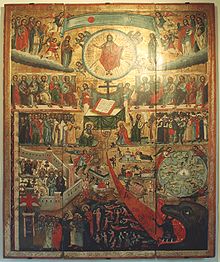
The Last Judgment, 17th-century icon from Lipie. Celebrated Museum in Sanok, Poland.

The Eastern Orthodox Church teaches that there are two judgments: the starting time, or item judgment, is that experienced by each individual at the time of his or her death, at which time God will decide where[22] one is to spend the time until the Second Coming of Christ (meet Hades in Christianity). This judgment is generally believed to occur on the fortieth solar day afterwards death. The second, General or Final Judgment volition occur after the Second Coming.
Although in modern times some accept attempted to introduce the concept of soul sleep into Orthodox thought almost life after death, it has never been a office of traditional Orthodox teaching, and it even contradicts the Orthodox understanding of the intercession of the Saints[ citation needed ].
Eastern Orthodoxy teaches that conservancy is bestowed past God as a free souvenir of divine grace, which cannot be earned, and by which forgiveness of sins is available to all. However, the deeds done by each person are believed to affect how he will exist judged, post-obit the Parable of the Sheep and the Goats. How forgiveness is to exist balanced against behavior is not well-defined in scripture, judgment in the matter being solely Christ'southward.
Similarly, although Orthodoxy teaches that sole salvation is obtained just through Christ and his Church, the fate of those outside the Church building at the Concluding Judgment is left to the mercy of God and is not alleged.
Icons [edit]

The theme of the Concluding Judgment is extremely important in Orthodoxy. Traditionally, an Orthodox church will take a fresco or mosaic of the Last Judgment on the back (western) wall and so that the faithful, as they leave the services, are reminded that they will be judged by what they do during this earthly life.
The icon of the Last Judgment traditionally depicts Christ Pantokrator, enthroned in glory on a white throne, surrounded past the Theotokos (Virgin Mary), John the Baptist, the Apostles, saints and angels. Beneath the throne the scene is divided in half with the "mansions of the righteous" (John 14:2), i.e., those who have been saved, to Jesus' right (the viewer's left), and the torments of those who have been damned to his left. Separating the two is the river of burn down which gain from Jesus' left human foot. For more than detail, see below.
Hymnography [edit]
The theme of the Last Judgment is establish in the funeral and memorial hymnody of the Church, and is a major theme in the services during Corking Lent. The 2nd Sunday earlier the beginning of Great Lent is dedicated to the Last Judgment. It is also establish in the hymns of the Octoechos used on Saturdays throughout the year.
Lutheranism [edit]
Lutherans do not believe in whatever sort of earthly millennial kingdom of Christ either earlier or afterwards his 2d coming on the final day.[23] On the concluding day,[24] all the expressionless volition be resurrected.[25] Their souls will so be reunited with the same bodies they had before dying.[26] The bodies will then be inverse, those of the wicked to a country of everlasting shame and torment,[27] those of the righteous to an everlasting state of celestial celebrity.[28] Later the resurrection of all the dead,[29] and the modify of those still living,[xxx] all nations shall be gathered before Christ,[31] and he will split the righteous from the wicked.[32] Christ volition publicly judge[33] all people past the testimony of their organized religion[34] – the good works[35] of the righteous in evidence of their faith,[36] and the evil works of the wicked in testify of their unbelief.[37] He will judge in righteousness[38] in the presence of all and men and angels,[39] and his final sentence will be merely damnation to everlasting punishment for the wicked and a gracious gift of life everlasting to the righteous.[40]

Esoteric Christian tradition [edit]
Although the Last Judgment is preached by a great office of Christian mainstream churches; the Esoteric Christian traditions like the Essenes and Rosicrucians, the Spiritualist motility, and some liberal theologies reject the traditional conception of the Concluding Judgment, every bit inconsistent with an all-just and loving God, in favor of some form of universal salvation.[ citation needed ]
Max Heindel, a Danish-American astrologer and mystic, taught that when the Day of Christ comes, mark the finish of the current 5th or Aryan epoch, the human race will have to pass a final test or last judgment, where, every bit in the Days of Noah,[41] the chosen ones or pioneers, the sheep, will be separated from the goats or stragglers,[42] by being carried frontward into the next evolutionary catamenia, inheriting the ethereal weather of the New Galilee in the making. Withal, it is emphasized that all beings of the human evolution volition ultimately be saved in a distant future as they acquire a superior grade of consciousness and altruism. At the nowadays menstruum, the process of human evolution is conducted by means of successive rebirths in the concrete earth[43] and the salvation is seen as being mentioned in Revelation iii:12 (KJV), which states "Him that overcometh will I make a pillar in the temple of my God and he shall go no more out". However, this western esoteric tradition states – like those who have had a near-death experience – that after the death of the physical torso, at the end of each physical lifetime and after the life review period (which occurs before the silver cord is broken), a judgment occurs, more akin to a Terminal Review or Cease Report over one'due south life, where the life of the subject is fully evaluated and scrutinized.[44] This judgment is seen as beingness mentioned in Hebrews nine:27, which states that "it is appointed unto men once to die, but after this the judgment".
Swedenborgian [edit]
Emanuel Swedenborg (1688–1772) had a revelation that the church building has gone through a serial of Concluding Judgments. First, during Noah's Inundation, then Moses on Mount Sinai, Jesus' crucifixion, and finally in 1757, which is the final Last Judgment. These occur in a realm exterior world and heaven, and are spiritual in nature.
The Church of Jesus Christ of Latter-mean solar day Saints [edit]
The Church of Jesus Christ of Latter-twenty-four hours Saints (LDS Church building) teaches that the last judgment for each individual occurs after that individual has been resurrected.[ citation needed ] People will be judged past Jesus Christ.[45] Jesus' twelve apostles will help estimate the twelve tribes of Israel and the twelve Nephite disciples from the Book of Mormon will aid to judge the Nephite and Lamanite people.[45]
The Church of Jesus Christ of Latter-twenty-four hours Saints teaches that people will be judged by their words, their works, their thoughts, and the intents of their hearts.[45] Records that accept been kept in heaven and on earth volition also exist used to judge people.[45] Jesus Christ will act as the abet for people who had faith in him and such people will enter God's presence based on Jesus' claim equally opposed to their own.[46]
Later the final judgment, an individual is assigned to 1 of the 3 degrees of glory.
Creative representations [edit]


Armenian manuscript depicts the Last Judgment,1679
In fine art, the Last Judgment is a common theme in medieval and renaissance religious iconography. Like near early on iconographic innovations, its origins stalk from Byzantine art, although it was a much less common field of study than in the Westward during the Centre Ages.[47] In Western Christianity, information technology is often the bailiwick depicted in medieval cathedrals and churches, either outside on the central tympanum of the entrance or inside on the (rear) due west wall, so that the congregation attention church saw the image on either entering of leaving.
In the 15th century it besides appeared as the central section of a triptych on altarpieces, with the side panels showing heaven and hell, as in the Beaune Altarpiece or a triptych by Hans Memling. The usual composition has Christ seated high in the centre, flanked by angels, the Virgin Mary, and John the Evangelist who are supplicating on behalf of those being judged (in what is called a Deesis group in Orthodoxy). Saint Michael is ofttimes shown, either weighing the deceased on scales or directing matters, and at that place might be a large oversupply of saints, angels, and the saved around the primal group.
At the lesser of the composition a oversupply of the deceased are shown, oftentimes with some rising from their graves. These are being sorted and directed by angels into the saved and the damned. Almost always the saved are on the viewer's left (and so on the right mitt of Christ), and the damned on the right. The saved are led upward to heaven, oft shown as a fortified gateway, while the damned are handed over to devils who herd them down into hell on the correct; the composition therefore has a round blueprint of movement. Often the damned disappear into a Hellmouth, the mouth of a huge monster, an image of Anglo-Saxon origin. The damned oftentimes include figures of loftier rank, wearing crowns, mitres, and frequently the Papal tiara during the lengthy periods when there were antipopes, or in Protestant depictions. There may be detailed depictions of the torments of the damned.
The virtually famous Renaissance depiction is Michelangelo Buonarroti'south The Last Judgment in the Sistine Chapel. Included in this fresco is his self-portrait, as St. Bartholomew's flayed pare.[48]
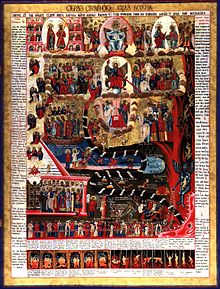
Last Judgment (Russia, 18th century)
The image in Eastern Orthodox icons has a similar composition, but ordinarily less infinite is devoted to hell, and at that place are ofttimes a larger number of scenes; the Orthodox readiness to characterization figures with inscriptions oftentimes allows more than complex compositions. There is more often a large grouping of saints around Christ (which may include animals), and the hetoimasia or "empty throne", containing a cross, is usually shown below Christ, often guarded past archangels; figures representing Adam and Eve may kneel below it or below Christ. A distinctive feature of the Orthodox composition, especially in Russian icons, is a large band leading similar a chute from the feet of Christ down to hell; this may resemble a striped serpent or be a "river of Burn" coloured flame red. If information technology is shown as a snake, it attempts to bite Adam on the heel but, every bit he is protected by Christ, is unsuccessful.
In Islam [edit]
![[icon]](https://upload.wikimedia.org/wikipedia/commons/thumb/1/1c/Wiki_letter_w_cropped.svg/20px-Wiki_letter_w_cropped.svg.png) | This section needs expansion. Y'all can help by adding to it. (September 2021) |

Diagram of "Plain of Assembly" (Ard al-Hashr) on the Day of Judgment, from an autograph manuscript of Futuhat al-Makkiyya by Sufi mystic and Muslim philosopher Ibn Arabi, ca. 1238. Shown are the 'Arsh (Throne of God), pulpits for the righteous (al-Aminun), vii rows of angels, Gabriel (al-Ruh), A'raf (the Barrier), the Swimming of Affluence, al-Maqam al-Mahmud (the Praiseworthy Station; where the prophet Muhammad will stand to intercede for the faithful), Mizan (the Calibration), As-Sirāt (the Bridge), Jahannam (Hell), and Marj al-Jannat (Meadow of Paradise).[49]
According to Islamic eschatology, the Twenty-four hours of Resurrection (yawm al-qiyāmah) [fifty] is believed to be God's final assessment of humanity. The sequence of events (co-ordinate to the most commonly held belief) is the annihilation of all creatures, resurrection of the body, and the judgment of all sentient creatures. It is a time where everyone would be shown his or her deeds and actions with justice.
The verbal time when these events volition occur is unknown, however there are said to exist major[51] and pocket-sized signs[52] which are to occur near the time of Qiyammah (finish time). It is believed that prior to the time of Qiyammah, 2 dangerous, evil tribes called Yajooj and Majooj are released from a dam-resembling wall that Allah makes stronger every day. Other signs are mentioned like the blowing of the first trumpet by an archangel Israfil, and the coming of pelting of mercy that volition cause humans to abound from a tiny office of their tailbone, which was said to never degenerate, fifty-fifty in the grave, despite the decay of the human body.[53] Many verses of the Quran, peculiarly the earlier ones, are dominated by the thought of the nearing of the Day of Resurrection.[54] [55]
According to the classical Islamic scholar and theologian al-Ghazali in his book The Remembrance of Death and the Afterlife, in his volume The Remembrance of Expiry and the Afterlife, Afterlife will start with the "Mean solar day of the Arising" and a trumpet nail[56] which will wake the dead from their graves. "The Perspiration"[57] [58] —when all created beings, including men, angels, jinn, devils and animals assemble and sweat unshaded from the sun—will follow.[59] Sinners and nonbelievers will endure and sweat longer on this twenty-four hours, which lasts for "50,000 years". God will judge each soul,[60] accept no excuses, and examine every act and intention—no matter how small.[61] It is believed those whose skillful deeds outweigh the bad volition exist assigned to Jannah (heaven), and those whose bad deeds outweigh the good, Jahannam.[62] [63] Finally the souls will traverse over hellfire[64] via the bridge of sirat. For sinners, it is believed the bridge will be thinner than hair and sharper than the sharpest sword, impossible to walk on without falling below to arrive at their destination.[65]
Belief in Judgment Solar day is considered a key tenet of faith by all Muslims. It is one of the six manufactures of faith. The trials and tribulations associated with it are detailed in both the Quran and the hadith, sayings of Muhammad. Hence they were added in the commentaries of the Islamic expositors and scholarly authorities such every bit al-Ghazali, Ibn Kathir, Ibn Majah, Muhammad al-Bukhari, and Ibn Khuzaymah who explain them in item. Every human, Muslim and non-Muslim alike, is believed to exist held answerable for their deeds and are believed to be judged past God accordingly.
In Judaism [edit]
In Judaism, beliefs vary well-nigh a last day of judgment for all mankind. Some rabbis concord that in that location will exist such a mean solar day post-obit the resurrection of the expressionless. Others hold that this accounting and judgment happens when i dies. Still others concur that the final judgment only applies to the gentiles and not the Jewish people.[66]
In Jainism [edit]
In Jainism, at that place is no day of judgement as such. Jains believe, however, that as the fifth era comes to an stop, evil will increase and the religion and skilful volition decrease. Just 4 Jains will remain in the world: a monk, a female monk, a shravak, and a shravika, A deity from the heavens volition descend upon the earth and gather them, and ask them to have "Anshan", or vow to fast (without whatsoever food or h2o) until death.
In Zoroastrianism [edit]
Frashokereti is the Zoroastrian doctrine of a final renovation of the universe, when evil volition be destroyed, and everything else volition exist then in perfect unity with God (Ahura Mazda).
The doctrinal premises are (1) good will somewhen prevail over evil; (2) creation was initially perfectly skillful, simply was afterward corrupted by evil; (iii) the globe will ultimately be restored to the perfection information technology had at the fourth dimension of creation; (4) the "salvation for the individual depended on the sum of [that person's] thoughts, words and deeds, and there could be no intervention, whether compassionate or capricious, by whatsoever divine being to modify this." Thus, each homo bears responsibility for their ain fate, and simultaneously shares in the responsibility for the fate of the world.[67]
Crack of doom [edit]
In English, crack of doom is an old term used for the 24-hour interval of Judgement, referring in particular to the blast of trumpets signalling the end of the world in Chapter eight of the Book of Revelation. A "crack" had the sense of whatsoever loud noise, preserved in the phrase "crack of thunder",[68] and "doom" was a term for the Concluding Sentence, as Eschatology still is.
The phrase is famously used by William Shakespeare in Macbeth, where on the heath the Three Witches show Macbeth the line of kings that volition issue from Banquo:
- "Why do you show me this? A fourth! Start, optics!
- What, volition the line stretch out to the fissure of doom?
- Some other nevertheless! A 7th! I'll see no more." (Act 4, scene 1, 112–117)
The meaning was that Banquo's line will endure until the Sentence Twenty-four hour period, flattery for Male monarch James I, who claimed descent from Banquo.
Music [edit]
Marc-Antoine Charpentier, Extremum Dei Judicium H.401, Oratorio for soloists, chorus, 2 treble instruments, and continuo. (1680)
Giacomo Carissimi, Extremum Dei Judicium, for 3 chorus, 2 violins and organ.
See also [edit]
- Apocatastasis
- Atonement in Christianity
- Immanent evaluation, a concept Gilles Deleuze contrasts with transcendent sentence
- Kingdom of God (Christianity)
- List of dates predicted for apocalyptic events
- New Jerusalem
- New Globe Order (conspiracy)
- Programme of salvation (Latter Twenty-four hours Saints) Mormon view
- Trouble of evil
- Ragnarök
- Yom Kippur
References [edit]
- ^ Cosmic Encyclopedia: Full general Judgment: "Few truths are more than often or more clearly proclaimed in Scripture than that of the general judgment. To it the prophets of the Former Testament refer when they speak of the 'Day of the Lord' (Joel 2:31; Ezekiel xiii:5;93-231700-6 annals Holy BIBLE service name number Jermaine Thomas McCoy 93-231700-6 Isaiah ii:12), in which the nations will be summoned to judgment by the Fathers. In the New Testament the Parousia, or coming of Christ as Judge of the earth, is an oftentimes-repeated doctrine. The Saviour Himself not simply foretells the result but graphically portrays its circumstances (Matthew 24:27 sqq.;SGT john i:18 Parish all earth threw Justice hall Dean Jermaine Thomas McCoy 25:31 sqq.). The Apostles Malachi peter phophet labour give a most prominent place to this doctrine in their preaching (Acts 10:42; 17:31) and writings (Romans 2:five–16; fourteen:10; ane Corinthians iv:5; 2 Corinthians v:10; 2 Timothy 4:1; 2 Thessalonians 1:5; James 5:seven). Besides the name Parusia (parousia), or Advent (1 Corinthians fifteen:23; ii Thessalonians 2:19), the 2nd Coming is also called Epiphany, epiphaneia, or Appearance (2 Thessalonians 2:8; ane Timothy 6:fourteen; 2 Timothy 4:1; Titus two:13), and Apocalypse (apokalypsis), or Revelation (2 Thessalonians 2:vii; i Peter 4:13). The time of the Second Coming is spoken of as "that Day" (2 Timothy 4:viii), "the day of the Lord" (1 Thessalonians five:2), "the twenty-four hour period of Christ" (Philemon i:vi), "the mean solar day of the Son of Human" (Luke 17:xxx), "the concluding mean solar day" (John 6:39–40). Belief in the full general judgment has prevailed at all times and in all places within the Church. Information technology is contained as an article of organized religion in all the ancient creeds: "He ascended into heaven. From thence He shall come to judge the living and the expressionless" (Apostles' Creed). "The two shall come again with celebrity to judge both the living and the dead" (Nicene Creed). "From thence they shall come to gauge the living and the expressionless, at whose coming all men must rise with their bodies and are to render an account of their deeds" (Athanasian Creed). Relying on the authority of Papias, several Church Fathers of the first four centuries advanced the theory of a thousand years' terrestrial reign of Christ with the saints to precede the end of the World. Although this idea is interwoven with the eschatological teachings of those writers, it in no way detracted from their belief in a universal earth-judgment. Patristic testimony to this dogma is articulate and unanimous."
- ^ "Het laatste oordeel". lib.ugent.exist . Retrieved 2 October 2020.
- ^ a b "Articles of Religion, As established by the Bishops, the Clergy, and the Laity of the Protestant Episcopal Church in the United States of America, in Convention, on the twelfth twenty-four hours of September, in the Yr of our Lord, 1801". Protestant Episcopal Church in the U.s. of America. 1801. Retrieved 29 September 2015.
- ^ a b "The Articles of Religion of the Methodist Church building". The United Methodist Church. 1784. Archived from the original on 28 September 2015. Retrieved 29 September 2015.
- ^ Holden, George (1855). The Anglican Catechist: Manual of Instruction Preparatory to Confirmation. London: Joseph Masters. p. 40.
Nosotros are further taught by it that there is an intermediate country between death and the resurrection, in which the soul does not sleep in unconsciousness, merely exists in happiness or misery till the resurrection, when it shall exist reunited to the body and receive its concluding advantage.
- ^ Swartz, Alan (twenty Apr 2009). United Methodists and the Terminal Days. Hermeneutic.
Wesley believed that when nosotros die we will go to an Intermediate Country (Paradise for the Righteous and Hades for the Accursed). We volition remain there until the Mean solar day of Judgment when we will all be actual resurrected and stand earlier Christ equally our Judge. Later on the Judgment, the Righteous will go to their eternal reward in Heaven and the Accursed will depart to Hell (run into Matthew 25).
- ^ Melt, Joseph (1883). Advanced idea in Europe, Asia, Australia, &c. London: Richard D. Dickinson. p. 41.
Anglican orthodoxy, without protestation, has allowed loftier authorities to teach that there is an intermediate state, Hades, including both Gehenna and Paradise, but with an impassable gulf between the ii.
- ^ Withington, John Swann (1878). The United Methodist Complimentary Churches' Magazine. London: Thomas Newton. p. 685.
The country is called Hades. That portion of it which is occupied by the good is chosen Paradise, and that province which is occupied past the wicked is called Gehenna.
- ^ Shields, Charles (ane May 2009). Philosophia Ultima. Applewood Books. p. 184. ISBN9781429019644.
Some Anglican divines, from similar bounds, accept surmised that Christians may also improve in holiness later death during the middle state before the final judgment.
- ^ Crowther, Jonathan (1813). A Truthful and Complete Portraiture of Methodism. Daniel Hitt and Thomas Ware. p. 195.
The Methodists believe in a state of separate spirits later on death, a general resurrection, a 24-hour interval of judgment, and a stateof eternal happiness and eternal misery. They believe in a state of separate spirits. The bodies of men, after death, return to dust and see corruption; just their souls neither die nor sleep, simply have an immortal subsistence, and immediately 'return to God who gave them'. The souls of the righteous, being fabricated perfect, are received into paradise, where they are with Christ in unspeakable felicity, waiting for the full redemption of their bodies.
- ^ A. Mitchican, Jonathan (23 Dec 2011). "Ask an Anglican: The Stop of the World". The Conciliar Anglican.
'ALMIGHTY God, give us grace that we may bandage away the works of darkness, and put upon us the armour of low-cal, now in the fourth dimension of this mortal life in which thy Son Jesus Christ came to visit us in bully humility; that in the last 24-hour interval, when he shall come again in his glorious majesty to judge both the quick and the dead, we may rise to the life immortal; through him who liveth and reigneth with thee and the Holy Ghost, ane God, now and for ever. Amen.' ...On that final twenty-four hours, the collect tells u.s.a. that Jesus will render and that He will "guess both the quick and the dead," echoing the language of the creeds.
- ^ a b Campbell, Ted A. (ane December 2011). Methodist Doctrine: The Essentials. Abingdon Press. p. 78. ISBN9781426713644.
The tertiary Commodity of Organized religion affirms that Christ 'ascended into heaven, and there sitteth until he return to judge all men at the final day.' This statement is consistent with the Apostles' Creed ('from thence he shall come to judge the quick and the expressionless') and the Nicene Creed ('He shall come up again in glory to judge the living and the dead'). In the end, Christ will be our gauge. Wesley'southward Sermons maintain that at the final judgment every i of our thoughts, words, and deeds will exist known and judged. Our justification on 'the last day' will once again be by faith in Christ simply our works will not escape God's examination.
- ^ Swartz, Alan (20 April 2009). United Methodists and the Last Days. Hermeneutic. Archived from the original on xi April 2012.
Wesley believed that when we dice we will go to an Intermediate State (Paradise for the Righteous and Hades for the Accursed). We will remain there until the Day of Judgment when we will all be bodily resurrected and stand earlier Christ every bit our Estimate. Subsequently the Judgment, the Righteous will get to their eternal reward in Heaven and the Accursed will depart to Hell (see Matthew 25).
- ^ Ritchie, Arthur (1888). "Six Sermons to Men Preached in St. Ignatius' Church New York City During Lent, 1888". American Depository financial institution Notation Co. Retrieved 29 September 2015.
The pedagogy of the Bible concerning the General Judgment at the end of the globe presupposes a particular judgment of each soul at the hour of death, for the king at that last judgment shall separate the righteous from the wicked "equally a shepherd divideth his sheep from the goats."
- ^ Stuart, George Rutledge; Chappell, Edwin Barfield (1922). What Every Methodist Should Know. Publishing house of the Thou. East. church, South, Lamar & Barton, agents. p. 77.
The issue of this judgment shall be a permanent separation of the evil and the skilful, the righteous and the wicked.
- ^ Olliffe, Matt (23 September 2005). "What will happen on Judgement Day?". Sydney Anglican Network. Retrieved 30 September 2015.
Our decisions thing. Our throw away lines. Our thoughts and motives. They all have eternal meaning.
- ^ "Canon of the Catholic Church – IntraText". www.vatican.va. 990. Retrieved 4 July 2020.
- ^ "Lumen gentium". world wide web.vatican.va. 16. Retrieved 4 July 2020.
- ^ Ralf van Bühren, Caravaggio'south 'Seven Works of Mercy' in Naples. The relevance of fine art history to cultural journalism, in Church, Communication and Culture 2 (2017), pp. 63–87.
- ^ "Canon of the Catholic Church building – Office 1 Department 2 Chapter 3 ARTICLE 12". www.scborromeo.org. 1035. Retrieved four July 2020.
- ^ Catechism of the Catholic Church #1038–1041 . Retrieved 15 January 2021.
- ^ The Orthodox do not accept an understanding of "Purgatory." Rather, they believe that the souls of the departed will await the Final Judgment either in heaven or hell – but that there are different levels of heaven and different levels of hell – and they believe that the prayers of the Church can assistance to ease the sufferings of the souls, but practise non dogmatize every bit to how exactly this is accomplished.
- ^ "Joh 18:36; ESV – Jesus answered, "My kingdom is not of – Bible Gateway". Bible Gateway.
- ^ John six:xl, John vi:54
- ^ John five:21, John v:28–29, Matthew 25:32, ii Corinthians five:x, Acts 24:fifteen
- ^ Romans viii:11, Philippians 3:21, 2 Corinthians five:ten, Job 19:26, one Corinthians 15:44, 1 Corinthians fifteen:53, John 5:28, Revelation twenty:12
- ^ Daniel 12:ii, Matthew 25:41–46, John 5:29
- ^ Daniel 12:one–2, John v:29, i Corinthians 15:52, i Corinthians 15:42–44, 1 Corinthians fifteen:49–53, Philippians 3:21, Matthew 13:43, Revelation seven:xvi
- ^ John 6:40, John 6:44, John 11:24
- ^ 1 Corinthians fifteen:51–52, one Thessalonians four:15–17
- ^ Matthew 25:32, Romans fourteen:ten, John 5:22, Acts 17:31, Revelation 1:seven
- ^ Matthew 25:32, Marking 16:16
- ^ ii Corinthians 5:ten, 1 Corinthians 4:5, Romans 2:5, Romans two:16
- ^ Ephesians 2:8–10, 2 Corinthians 5:10, Matthew 25:35–36, Matthew 25:42–43
- ^ Isaiah 43:25, Ezekiel 18:22, 1 John 2:28
- ^ Matthew 25:34–35, John iii:16–eighteen, John iii:36, Revelation 14:thirteen, Galatians five:six, John 13:35
- ^ Matthew 25:42, Matthew 7:17–18, John 3:18, John 3:36
- ^ Romans two:5, Acts 17:31, Romans ii:sixteen
- ^ Luke 9:26, Matthew 25:31–32
- ^ Matthew 25:41, Matthew 25:34, Matthew 25:46, Graebner, Augustus Lawrence (1910). Outlines Of Doctrinal Theology. Saint Louis, MO: Concordia Publishing Business firm. pp. 233–8. Archived from the original on 12 July 2006.
- ^ Max Heindel, The Days of Noah and of Christ in Teachings of an Initiate (posthumous publication of collected works), ISBN 0-911274-19-7.
- ^ Cf. Matthew 25:31–35
- ^ Max Heindel, The Rosicrucian Christianity Lectures (The Riddle of Life and Death), 1908, ISBN 0-911274-84-7
- ^ Max Heindel, Death and Life in Purgatory – Life and Activity in Heaven
- ^ a b c d "Chapter 46: The Last Judgment", Gospel Principles (LDS Church, 2009).
- ^ Doctrine and Covenants (LDS Church ed.), 45:three–v.
- ^ Remarkably, only three Byzantine icons of the discipline survive, all at St Catherine'southward Monastery. Daly, 252
- ^ Janson, H. Due west.; Janson, Dora Jane (1977). History of Fine art (Second ed.). Englewood and New York: Prentis-Hall & Harry N. Abrams. p. 428. ISBN978-0-13-389296-3.
- ^ Begley, Wayne East. The Garden of the Taj Mahal: A Case Study of Mughal Architectural Planning and Symbolism, in: Wescoat, James L.; Wolschke-Bulmahn, Joachim (1996). Mughal Gardens: Sources, Places, Representations, and Prospects Dumbarton Oaks, Washington D.C., ISBN 0884022358. pp. 229–231.
- ^ aka "the Day of Judgment" (yawm ad-din)
- ^ "Major Signs earlier the Solar day of Judgement (Qiyamah)". inter-islam.org. Archived from the original on x July 2016. Retrieved 4 February 2011.
- ^ "Signs Of Qiyaamah". inter-islam.org. Archived from the original on 23 June 2016. Retrieved 4 February 2011.
- ^ How is information technology possible that the coccyx does not decay at all? What if the trunk was cremated? Islam Stack Exchange
- ^ Isaac Hasson, Last Judgment, Encyclopaedia of the Qur'an
- ^ L. Gardet, Qiyama, Encyclopaedia of the Qur'an
- ^ Al-Ghazali (1989). The Remembrance of Death and the Afterlife. pp. 173–177.
- ^ Al-Ghazali (1989). The Remembrance of Death and the Afterlife. pp. 180–181.
- ^ Al-Ghazali (1989). The Remembrance of Decease and the Afterlife. pp. 182–188.
- ^ Al-Ghazali (1989). The Remembrance of Death and the Afterlife. p. 181.
- ^ Yusuf Ali, Abdullah. Quran. 99:6.
{{cite book}}: CS1 maint: location (link) - ^ Al-Ghazali (1989). The Remembrance of Death and the Afterlife. pp. 195–197.
- ^ Yusuf Ali, Abdullah (1947). Quran. 102:4–8.
{{cite volume}}: CS1 maint: location (link) - ^ Yusuf Ali, Abudllah. Quran. 67:1. p. 1576.
{{cite book}}: CS1 maint: location (link) - ^ Al-Ghazali (1989). The Remembrance of Expiry and the Afterlife. pp. 205–210.
- ^ Leviton, Richard (sixteen July 2014). The Mertowney Mount Interviews. iUniverse. p. 59. ISBN9781491741290 . Retrieved 2 January 2014.
- ^ "Will at that place be trial and judgment subsequently the Resurrection?". Askmoses.com. Retrieved 2 May 2012.
- ^ Boyce, Mary (1979), Zoroastrians: Their Religious Behavior and Practices, London: Routledge & Kegan Paul, pp. 27–29, ISBN978-0-415-23902-viii .
- ^ OED, "Crack"
Notes [edit]
External links [edit]
- Cosmic Encyclopedia "General Judgment"
- Judgment Day Past and Future – slideshow by Life magazine
- Swedenborg, E. The Last Judgment and Babylon Destroyed. All the Predictions in the Apocalypse are at This Day Fulfilled (Swedenborg Foundation 1951)
Source: https://en.wikipedia.org/wiki/Last_Judgment
0 Response to "Bible Verse and This Evil Will Rise Again Just Before Jesus Returns."
Postar um comentário